200TPH Two-Stage Ball Mill Grinding Circuit for Gold Ore Processing in Russia
Project Background
Sibirsky Gold Mining JSC, a gold mining company operating an open-pit gold mine in the Krasnoyarsk region of Siberia, Russia, required a complete grinding and classification circuit upgrade to process a newly developed ore body with a finer liberation size than the existing deposit. The company's metallurgical engineer, Mr. Alexei Volkov, began evaluating grinding mill suppliers in mid-2022. He found Xianglong Machinery through a Google search for "ball mill manufacturer for gold ore" and also followed XLM's LinkedIn page, where he read several technical articles on ball mill sizing and gold ore grinding. He sent an inquiry via email to XLM's international sales department.
Channel Communication and Needs Assessment
XLM's Russia and CIS sales engineer, Mr. Kevin Liu, responded to the email within 24 hours and established ongoing communication via WhatsApp. Mr. Volkov described the ore characteristics: a gold-bearing quartz vein ore with a Bond Work Index of approximately 14-16 kWh/t, a feed size of minus 20 mm from the secondary crusher, and a target grind size of P80=74 microns for optimal gold recovery in the downstream CIL circuit. The required throughput was 200 tonnes per hour.
Technical Solution and Engineering Alignment
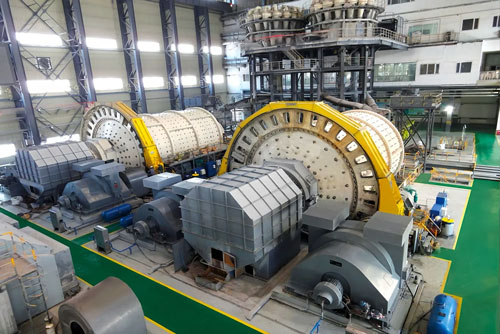
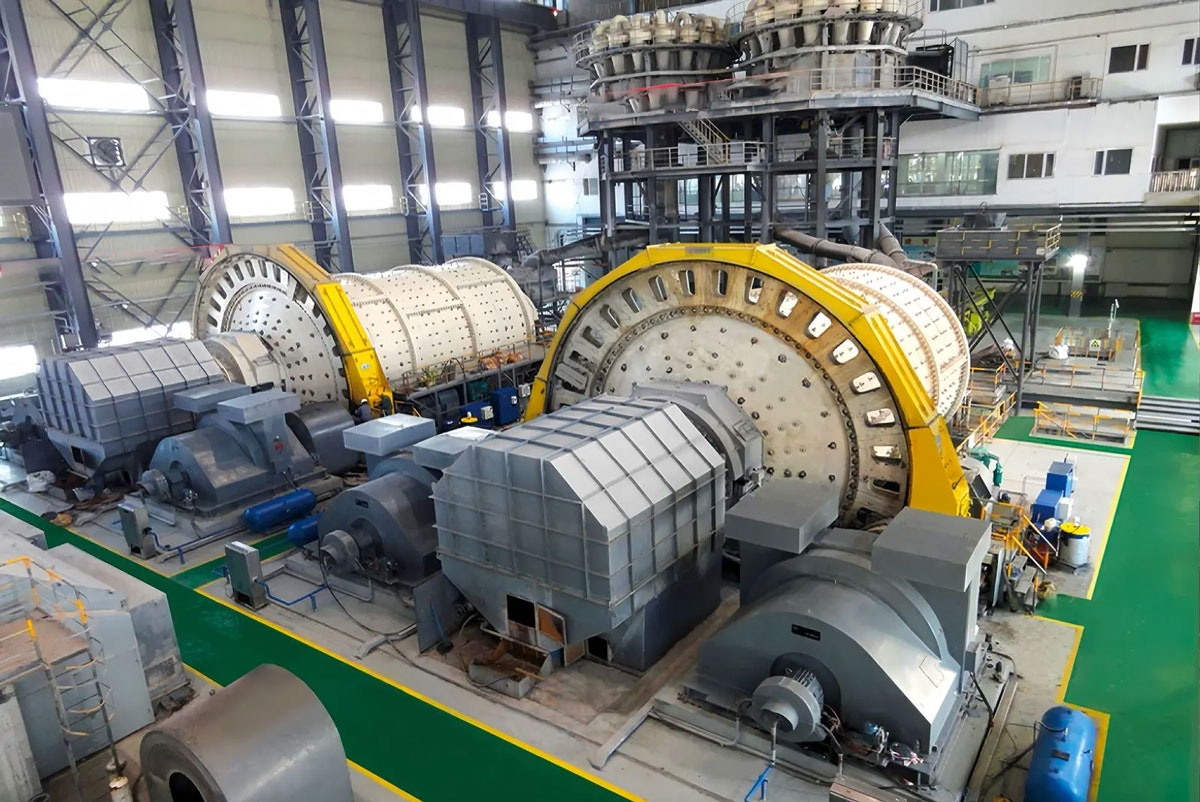
XLM's grinding specialist, Mr. Henry Wu, designed a two-stage ball mill grinding circuit -- the industry-standard configuration for gold ore processing at this throughput and target fineness. The primary grinding stage used a MQG-3.6x7.5 Ball Mill in open circuit, reducing the ore from minus 20 mm feed to approximately P80=200 microns. The discharge from the primary mill was classified by a bank of hydrocyclones; the coarse underflow was returned to the primary mill, while the overflow at P80=200 microns advanced to the secondary grinding stage. The secondary stage used a MQG-3.2x6.0 Ball Mill operating in closed circuit with a second bank of hydrocyclone classifiers, achieving the final target grind size of P80=74 microns for optimal gold liberation ahead of the CIL circuit. Both Ball Mills were lined with composite rubber-steel liner systems to minimise wear in the moderately abrasive quartz-vein ore. A ZSW-490x110 Vibrating Feeder provided controlled feed rate management to the primary mill, and the entire circuit was designed for continuous wet-grinding operation with slurry transfer between stages.
Technical discussions were conducted over six weeks via WhatsApp video calls and email. Henry provided detailed power consumption calculations, liner wear rate estimates, and a grinding circuit simulation confirming the target grind size could be achieved at 200TPH. Critical engineering adaptations were designed for Siberia's extreme subarctic conditions: foundation drawings specified pile foundations penetrating 4-5m through permafrost to stable bearing strata, with frost-protected concrete mixes (air-entrained, frost-resistant grade M400); ball mill liners were upgraded to low-temperature alloy steel (impact toughness rated to -50°C) instead of standard rubber-steel composite which becomes brittle in extreme cold; lubrication systems were equipped with electric trace heating and insulation; all hydraulic and lube oils were specified as arctic-grade (pour point -50°C); and the mill drive motors were rated for cold-start operation at -45°C with space heaters for standby periods. Equipment delivery was scheduled for May 2023 to avoid winter construction constraints. Russian-language operation and maintenance manuals were provided. The contract was signed in September 2022, with a delivery period of 100 days.
Delivery, Installation, and Commissioning
Equipment was shipped from Qingdao to Vladivostok and transported by rail to Krasnoyarsk. XLM dispatched grinding engineer Mr. Henry Wu and mechanical specialist Mr. Chris Fang to Russia for a 22-day commissioning engagement. The two-stage ball mill grinding circuit achieved a combined throughput of 205TPH at a final grind size of P80=71 microns during the acceptance test, slightly exceeding both throughput and fineness targets.
Results and Client Feedback
Within three months of commissioning, Sibirsky Gold Mining reported that the improved grind fineness had increased gold recovery in the CIL circuit by 4.2 percentage points -- from 87.1% to 91.3% -- a highly significant improvement at prevailing gold prices. Annual additional revenue from the improved recovery was estimated at approximately USD 3.8 million. Mr. Alexei Volkov stated: "XLM's Ball Mill has delivered exactly the grinding performance our metallurgists predicted. The improvement in gold recovery has more than justified the capital investment. We are planning a further expansion of our Krasnoyarsk operation and will be engaging XLM as our primary equipment supplier for the new grinding circuit."
150TPH VSI High Efficiency Vertical Shaft Sand Making Machine for Manufactured Sand in the UAE
500TPH TC116 Track-mounted Mobile Primary Crusher for Limestone Quarrying in Saudi Arabia
Related Article