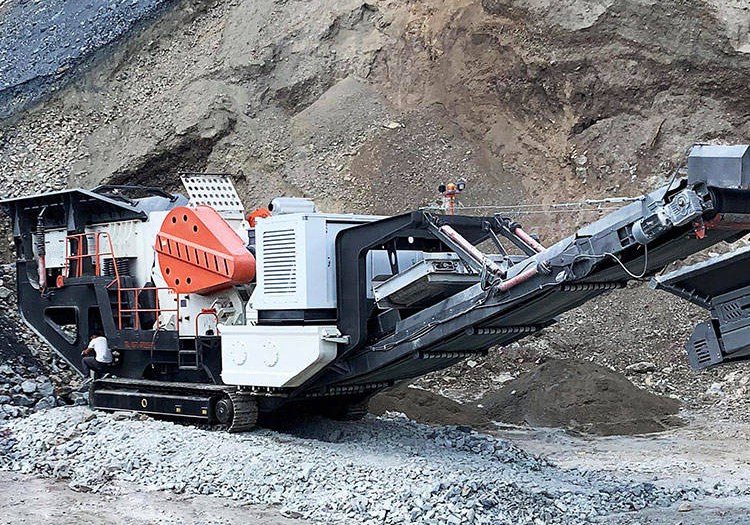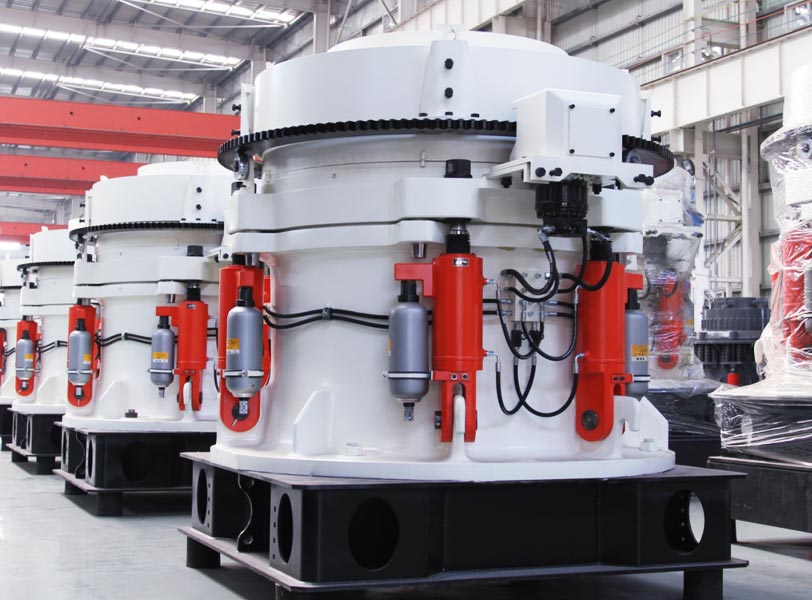
How Does a Jaw Crusher Work? Complete Working Principle
1. Introduction to Jaw Crushers: Position and Value in Industrial Crushing
In stone crushing production, primary crushing determines the stability, efficiency and economy of the entire production line. Among all primary crushers, the jaw crusher is the most widely adopted due to its simple structure, strong adaptability, high reliability, low operational cost and ability to handle materials with compressive strength up to 320 MPa. Unlike impact crushers, cone crushers or hammer mills that rely on impact, shearing or grinding, jaw crushers apply static-dynamic combined compressive force—the most energy-efficient way to break brittle and hard materials along their natural fissures.
XLM Machinery jaw crushers are designed based on mature Blake-type toggle mechanisms with upgraded kinematic trajectories, optimized toggle angles, enlarged effective cavity depth, enhanced bearing systems and hydraulic or gasket-type discharge adjustment. They are widely deployed in open-pit mines, stone quarries, road & bridge construction, water conservancy projects, railway ballast production and construction waste recycling. The core value of XLM jaw crushers lies in:
- Stable throughput under heavy-load, long-cycle working conditions
- High crushing ratio and uniform particle size distribution
- Low energy consumption and low wear-part consumption
- Easy adjustment, simple maintenance and high uptime
- Strong resistance to uncrushable objects and overload protection
2. Core Structural Composition of XLM Jaw Crushers
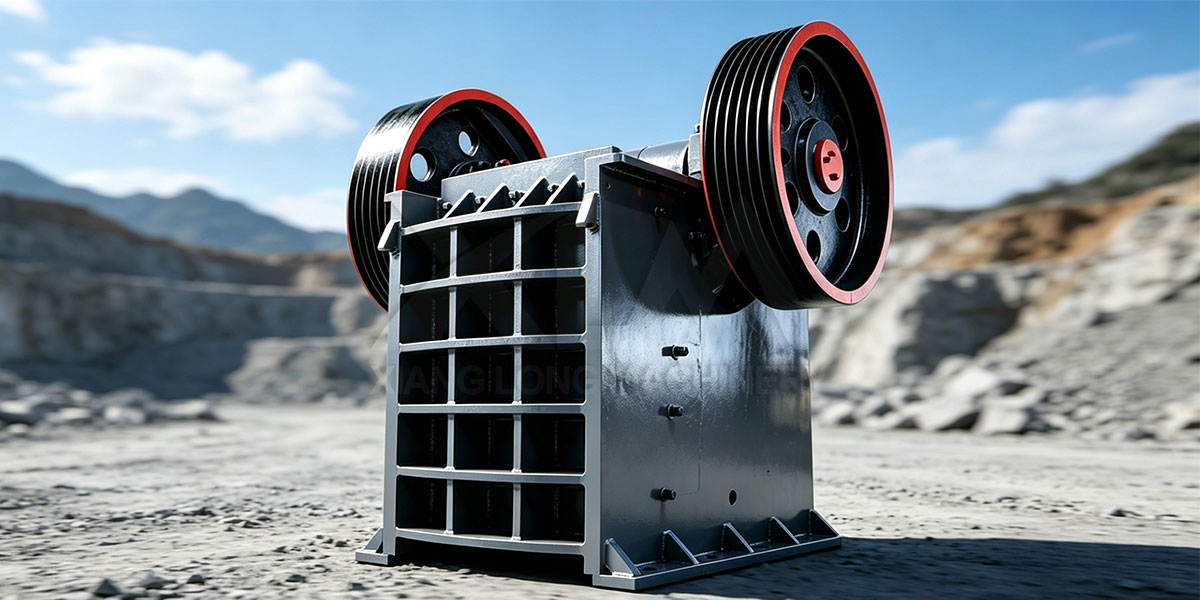
The working principle of a jaw crusher is fully embodied in the coordinated movement of its core components. XLM PE/PEX series jaw crushers consist of eight functional modules, each designed to match the overall motion law and force transmission path.
2.1 Frame (Body Structure)
The frame is the load-bearing foundation that withstands huge reactive crushing forces. XLM adopts integral cast steel frames or high-strength thick steel plate welded frames with stress-relief annealing treatment. The frame features high rigidity, low deformation, strong seismic resistance and long service life, ensuring stable alignment of the eccentric shaft, jaw assembly and toggle seat under continuous heavy load. The frame integrates a feeding guide, side guards, lubrication passages and adjustment spaces, forming a compact and robust carrier.
2.2 Fixed Jaw Assembly
The fixed jaw (stationary jaw) is rigidly mounted on the front wall of the frame. It consists of a jaw seat and a high-manganese steel jaw plate with special tooth profile. The fixed jaw provides a stable reaction surface for material crushing. XLM fixed jaw plates are made of Mn13Cr2 wear-resistant material with optimized tooth height, tooth pitch and surface hardness. They support reversible installation to extend service life and reduce operating costs.
2.3 Swing Jaw Assembly (Movable Jaw)
The swing jaw is the core moving component that performs periodic crushing motion. It is suspended on the forged eccentric shaft via heavy-duty self-aligning roller bearings. The lower part of the swing jaw rests on the toggle plate. XLM swing jaw assemblies adopt integrated casting or high-precision welding structure with balanced weight distribution. The swing jaw is equipped with a replaceable wear jaw plate identical to the fixed jaw in material and tooth profile, ensuring consistent crushing performance.
2.4 Eccentric Shaft & Transmission System
The eccentric shaft is the power input and motion conversion core. It is made of high-quality alloy steel after forging, precision machining and heat treatment, with high torsional strength and fatigue resistance. The transmission system includes an electric motor, V-belts, flywheel and pulley. The flywheel stores rotational energy during the idle stroke to smooth power fluctuation and reduce motor load. XLM’s transmission system is designed for low noise, high transmission efficiency and stable speed, ensuring consistent motion frequency of the swing jaw.
2.5 Toggle Plate & Toggle Seat
The toggle plate (thrust plate) is a dual-function component: it transmits motion and acts as an overload safety device. Made of high-strength cast iron with controlled brittleness, the toggle plate breaks first when uncrushable materials (such as iron blocks) enter the cavity, protecting the eccentric shaft, bearings and frame from damage. The toggle seat is fixed on the rear of the frame, providing a stable support point for the toggle plate. XLM uses precision-machined toggle plates and seats with close fitting, low wear and reliable fracture protection.
2.6 Discharge Gap Adjustment System
The adjustment system controls the final product size by changing the discharge opening width. XLM provides two mature solutions:
- Gasket-type adjustment: By adding or removing high-precision steel gaskets behind the toggle seat, users can achieve stepless, stable and accurate gap setting.
- Hydraulic adjustment: For large and medium models, a hydraulic cylinder drives the adjustment mechanism, enabling fast, on-load and remote adjustment with high efficiency.
The adjustment range covers most primary and secondary crushing requirements, ensuring flexible adaptation to different aggregate specifications.
2.7 Tension Rod & Return Spring System
The tension rod connects the lower part of the swing jaw to the frame, with a pre-tensioned return spring. The system pulls the swing jaw back to its original position after each crushing stroke, keeping the toggle plate tightly fitted and ensuring stable motion circulation. XLM’s spring system features durable springs, reliable locking and stable reset force, avoiding abnormal movement or noise.
2.8 Lubrication & Protection System
XLM jaw crushers are equipped with a centralized lubrication system that supplies grease or thin oil to the eccentric shaft bearings, toggle plate contact surfaces and tension rod bearings. The system ensures sufficient lubrication under heavy load and high temperature, reducing friction and extending component life. Sealing structures adopt labyrinth design to prevent dust and slurry intrusion, adapting to harsh on-site environments.
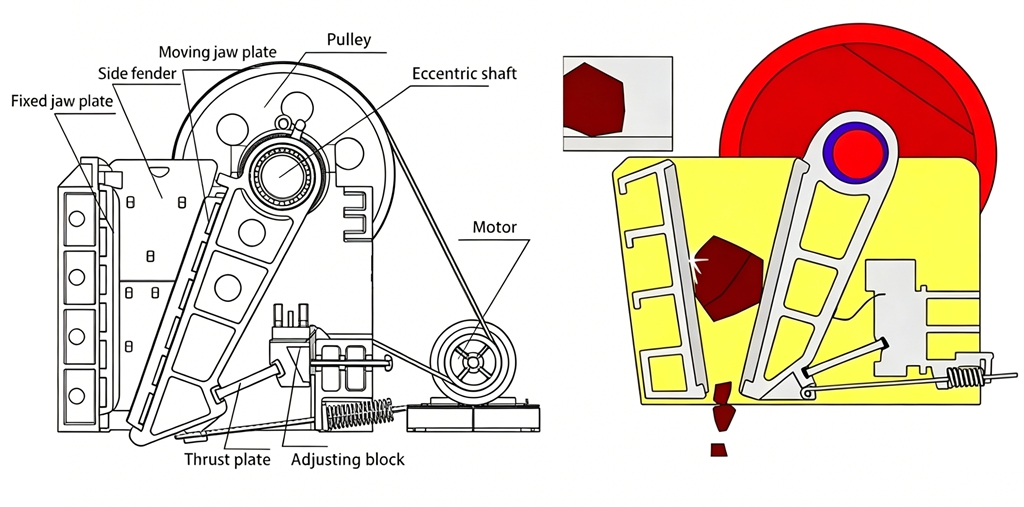
These eight modules work in strict coordination. The motor drives the eccentric shaft to rotate; the eccentric motion pushes the swing jaw; the toggle plate guides the trajectory; the spring ensures return; the two jaw plates generate compression; materials are crushed and discharged; and the cycle repeats continuously. This is the physical basis of the jaw crusher’s working principle.
3. Complete Working Principle: Kinematics, Force and Cycle Process
The working principle of XLM jaw crushers can be summarized in one sentence: the motor drives the eccentric shaft to rotate, which drives the swing jaw to perform periodic compound motion approaching and leaving the fixed jaw; materials are squeezed, split and bent in the wedge-shaped crushing cavity until they are small enough to be discharged by gravity. This section explains the principle from three dimensions: kinematic law, force transmission and full workflow.
3.1 Kinematic Principle: Compound Motion of the Swing Jaw
Different from simple swing motion, XLM jaw crushers adopt a complex pendulum motion mechanism (compound swing jaw structure). The swing jaw’s upper end is directly mounted on the eccentric shaft, while its lower end is supported by the toggle plate. When the eccentric shaft rotates, every point on the swing jaw follows an elliptical or approximate circular trajectory. The motion characteristics are:
- Upper part: approximate circular motion with large stroke
- Middle part: elliptical motion with balanced stroke and force
- Lower part: small-stroke swing with strong extrusion effect
This trajectory is optimized by XLM to enhance material downward sliding and layered crushing, avoiding material retention or upward ejection. The motion cycle matches the eccentric shaft rotation speed (usually 180–330 r/min depending on model), ensuring high-frequency and stable crushing.
The core kinematic parameter is the nip angle (the angle between fixed jaw and swing jaw), controlled within 18°–24° for XLM crushers. A reasonable nip angle ensures:
- Sufficient crushing force
- Smooth material downward flow
- No slipping or upward pushing
- High crushing efficiency
Too large a nip angle causes material slipping and reduced output; too small reduces crushing ratio. XLM’s optimized nip angle is a key result of decades of engineering practice.
3.2 Force Transmission Principle: From Motor Power to Crushing Force
The force transmission path of XLM jaw crushers is clear and efficient:
- Electric motor outputs rotational torque
- V-belts transmit torque to the pulley and flywheel
- Eccentric shaft converts rotation into eccentric push force
- Swing jaw receives push force and transmits it to the toggle plate
- Toggle plate transmits reaction force to the frame
- The wedge-shaped cavity forms a strong compressive field between two jaw plates
- Materials bear compressive, splitting and bending forces until fractured
The crushing force generated by XLM jaw crushers can reach hundreds of tons, sufficient to break granite, basalt, iron ore, copper ore and concrete blocks. Since force is applied along natural material fissures, energy consumption is lower than impact crushing. The toggle mechanism amplifies force while controlling motion stroke, achieving a balance between crushing strength and structural safety.
As a safety design, the toggle plate is the weak link: when overload occurs, the toggle plate fractures to cut off force transmission, protecting high-value components such as the eccentric shaft and bearings. This passive safety mechanism is simple, reliable and low-cost to replace.
3.3 Full Working Cycle: Four Continuous Stages
The working process of XLM jaw crushers is a continuous closed cycle divided into four stages. Each rotation of the eccentric shaft completes one cycle.
Stage 1: Feeding & Idle Return (Swing Jaw Retreating)
As the eccentric shaft rotates to the return position, the return spring pulls the swing jaw away from the fixed jaw. The nip angle increases, and the crushing cavity space expands. Materials fed from the top feeding inlet slide downward into the cavity under gravity and friction. Large bulk materials are held in the upper cavity, ready for crushing. This stage is the idle stroke, during which the flywheel stores energy to prepare for the next crushing stroke.
Stage 2: Crushing Stroke (Swing Jaw Approaching)
The eccentric shaft continues rotating, pushing the swing jaw toward the fixed jaw. The nip angle decreases rapidly, and the space between the two jaw plates shrinks. Materials are strongly compressed, split and bent. Cracks expand along internal fissures, and large pieces break into smaller lumps. The downward movement of the swing jaw pushes materials further into the narrower lower cavity, where they receive secondary extrusion. This is the effective working stroke, where most energy is converted into crushing force.
Stage 3: Continuous Gradient Crushing
Due to the wedge-shaped (top-wide, bottom-narrow) cavity design, materials undergo layered gradient crushing as they move downward. Upper parts break large blocks; middle parts further reduce size; lower parts perform final sizing. This gradient mechanism ensures uniform particle size and avoids excessive fine powder. XLM’s deep cavity design eliminates dead zones, improves feeding capacity and increases throughput by 15–20% compared with conventional structures.
Stage 4: Discharge & Cycle Reset
When the swing jaw reaches the maximum forward position, it immediately begins to retreat. The discharge gap opens, and qualified materials fall through the outlet under gravity. Unqualified larger particles remain in the cavity for the next crushing cycle. After full discharge, the mechanism resets to the feeding state, and a new cycle starts.
The entire cycle is continuous, stable and efficient. Under rated working conditions, XLM jaw crushers complete 180–330 crushing cycles per minute, realizing continuous large-volume primary crushing.
4. Material Crushing Physics: Why Jaw Crushers Break Hard Materials Efficiently
The working principle of jaw crushers is not only mechanical motion but also matches the fracture characteristics of brittle materials. XLM crushers apply the most suitable stress form to achieve high-efficiency, low-consumption crushing.
4.1 Dominant Crushing Forces
Three forces act simultaneously on materials in the cavity:
- Compressive force: The main force that squeezes materials to produce internal cracks
- Splitting force: Tooth profiles on jaw plates concentrate stress to split materials along weak planes
- Bending force: Uneven surface of bulk materials creates bending moments to accelerate fracture
Compressive crushing is the most efficient for hard and brittle materials such as rock and ore, with higher energy utilization than impact or shear.
4.2 Layered Crushing Mechanism
XLM’s deep V-shaped cavity strengthens layered crushing:
- Upper zone: coarse breaking of large blocks
- Middle zone: medium crushing to reduce size gradient
- Lower zone: fine sizing to control discharge particle size
This layered mode reduces repeated crushing, lowers energy consumption and wear, and improves product uniformity.
4.3 Gravity-Assisted Discharge
Discharge relies entirely on gravity without forced conveying, making the structure simple and failure-free. The gradient of the jaw plates and motion trajectory of the swing jaw promote downward flow, avoiding blockage even for moist or sticky materials.
4.4 Adaptability to Material Properties
XLM jaw crushers handle materials with varying properties:
- High hardness (basalt, granite, iron ore): high compressive force breaks effectively
- Brittle (limestone, concrete): splitting force achieves high efficiency
- Moisture content <10%: no significant adhesion or blockage
- Abrasive materials: wear-resistant jaw plates extend service life
This wide adaptability is why jaw crushers are irreplaceable in primary crushing.

5. XLM Proprietary Optimizations Based on Working Principle
Based on the classic working principle, XLM Machinery has carried out targeted optimizations to improve performance, stability and economy.
- 5.1 Optimized Kinematic Trajectory
XLM adjusts eccentric distance, swing jaw ratio and toggle length to obtain the best motion track. The trajectory enhances downward pushing, reduces slip and wear, and increases throughput. - 5.2 High-Strength Frame & Bearing System
Larger bearing models and reinforced frames improve load capacity and service life, supporting 24-hour continuous operation. - 5.3 Wear-Resistant Jaw Plates
Mn13Cr2 material with special heat treatment offers high toughness and hardness. Under impact load, the surface work-hardens to improve wear resistance. Reversible installation doubles service life. - 5.4 Flexible Discharge Adjustment
Gasket and hydraulic adjustment systems meet different product size requirements with high precision and convenience. - 5.5 Reliable Overload Protection
The toggle plate safety system effectively protects the main machine, reducing downtime and maintenance costs. - 5.6 Centralized Lubrication & Sealing
Labyrinth seals and centralized lubrication lower failure rates and extend maintenance intervals.
These optimizations do not change the basic working principle but upgrade mechanical efficiency, stability and economy, making XLM jaw crushers more suitable for modern industrial production.
6. Key Operating Parameters and Their Influence on Working Performance
To fully exert the working principle, users must control key parameters correctly. XLM provides clear setting guidance for stable and efficient operation.
- 6.1 Eccentric Shaft Rotation Speed
Speed affects cycle frequency and discharge speed. Too high causes incomplete discharge and blockage; too low reduces output. XLM’s rated speed is optimized for each model to balance capacity and efficiency. - 6.2 Nip Angle
Controlled at 18°–24° to ensure force and flow stability. XLM’s fixed design avoids manual adjustment errors. - 6.3 Discharge Gap Setting
Determines product size. Users set according to aggregate specifications. Larger gap = higher output; smaller gap = higher crushing ratio. - 6.4 Feeding Uniformity
Uniform, full-cavity feeding ensures balanced stress, stable output and uniform particle size. Side feeding or overloading causes uneven wear and reduced efficiency. - 6.5 Tension of Return Spring
Proper spring tension ensures reliable return and tight toggle fitting. Insufficient tension causes noise and abnormal motion. - 6.6 Lubrication Status
Adequate lubrication reduces friction and overheating. Regular oil supply and sealing inspection are mandatory.
Correct parameter settings align with the inherent working principle, maximizing performance while protecting the equipment.
7. Operational Safety and Protection Mechanism Based on Working Principle
The working principle determines the safety design logic of XLM jaw crushers.
- 7.1 Overload Protection by Toggle Plate Fracture
Uncrushable objects trigger toggle plate fracture, stopping force transmission and protecting key components. Replacement is fast and low-cost. - 7.2 No-Load Start Requirement
Starting with material in the cavity causes overload. XLM requires no-load start and sequential feeding after stable operation. - 7.3 Emergency Stop and Lockout
Control systems support immediate stop and mechanical lockout to prevent accidental movement during maintenance. - 7.4 Guarding and Interlock
Feeding inlet guards, transmission part covers and interlock switches ensure operator safety. - 7.5 Bearing Temperature Monitoring
Temperature sensors detect overheating, preventing bearing seizure and shaft damage.
Safety mechanisms are fully integrated with the working principle, ensuring reliable protection without affecting efficiency.
8. Maintenance Logic Corresponding to Working Principle
Maintenance of XLM jaw crushers follows the working principle to ensure long-term stable operation.
- 8.1 Jaw Plate Maintenance
Check wear regularly; reverse or replace when worn to maintain crushing efficiency and tooth profile function. - 8.2 Toggle Plate and Seat Inspection
Check fitting and cracks; replace fractured toggle plates immediately to avoid secondary damage. - 8.3 Bearing and Lubrication System
Regular greasing or oil change; check sealing to prevent dust intrusion. - 8.4 Tension Rod and Spring
Check tension and fatigue; replace weakened springs to ensure stable return. - 8.5 Frame and Connection Parts
Tighten bolts; inspect for cracks to maintain rigidity. - 8.6 Adjustment Mechanism
Keep clean and flexible; ensure accurate discharge gap.
Maintenance targets the key motion and force components, directly supporting the effective execution of the working principle.
9. Comparison with Other Crushers: Why Jaw Crusher Principle Is Unique
To highlight the uniqueness of the jaw crusher’s working principle, we compare it with other mainstream crushers.
- 9.1 vs. Impact Crusher
Impact crusher: uses high-speed impact and shearing; high reduction ratio, fine product, high wear and energy consumption
Jaw crusher: uses compressive force; simple structure, high reliability, low cost, suitable for primary crushing - 9.2 vs. Cone Crusher
Cone crusher: layered extrusion with high-speed rotation; suitable for secondary/tertiary crushing
Jaw crusher: large feed opening, strong block handling, ideal for primary crushing - 9.3 vs. Hammer Crusher
Hammer crusher: impact grinding; light structure, high fine powder, severe wear
Jaw crusher: low wear, high hardness adaptability, long service life
The jaw crusher’s compressive principle makes it the best choice for primary crushing of large, hard, abrasive materials.
10. Typical Application Cases: Working Principle in Real Production
XLM jaw crushers have been widely used globally, with the working principle fully validated.
- 10.1 Mining Primary Crushing
In iron ore and gold mines, XLM jaw crushers stably crush large ore blocks, providing uniform feed for grinding lines with high uptime and low operating cost. - 10.2 Construction Aggregate Production
For granite and basalt, the deep cavity and optimized trajectory ensure high output and uniform gradation, meeting highway and railway aggregate standards. - 10.3 Construction Waste Recycling
The strong compressive force crushes concrete and bricks; the overload protection handles steel bars, realizing efficient recycling. - 10.4 Quarry Portable Crushing
Portable XLM jaw crushers use the same working principle with compact structure, flexible deployment and on-site crushing.
In all cases, the reliable working principle ensures stable performance.
11. Conclusion: The Complete Working Principle of XLM Jaw Crushers Summarized
The complete working principle of XLM jaw crushers can be concluded as a closed-loop system of motion – force – fracture – discharge:
- Motion loop: Motor → belt → eccentric shaft → swing jaw compound motion → return spring reset
- Force loop: Torque → eccentric thrust → compressive/splitting/bending force → frame reaction
- Fracture loop: Wedge cavity → layered gradient crushing → particle size control
- Discharge loop: Gravity → qualified particle discharge → cycle repetition
Supported by XLM’s optimized design—deep V cavity, optimized trajectory, high-strength structure, wear-resistant parts, flexible adjustment and reliable protection—the principle achieves high efficiency, stability, economy and safety.
This document provides a full interpretation for users to understand, operate and maintain XLM jaw crushers. Mastery of the working principle helps optimize parameters, reduce failures, lower costs and maximize return on investment.
XLM Machinery will continue to optimize jaw crusher technology based on the classic working principle, providing more reliable, efficient and intelligent primary crushing solutions for global industrial users.
Jaw Crusher Price: What Factors Affect the Cost?
Jaw Crusher: The Ultimate Guide to Jaw Crushers | XLM Machinery